The rapid growth of Artificial Intelligence-Generated Content (AIGC) raises concerns about the authenticity of digital media. In this context, image self-recovery, reconstructing original content from its manipulated version, offers a practical solution for understanding the attacker's intent and restoring trustworthy data. However, existing methods often fail to accurately recover tampered regions, falling short of the primary goal of self-recovery. To address this challenge, we propose ReImage, a neural watermarking-based self-recovery framework that embeds a shuffled version of the target image into itself as a watermark. We design a generator that produces watermarks optimized for neural watermarking and introduce an image enhancement module to refine the recovered image. We further analyze and resolve key limitations of shuffled watermarking, enabling its effective use in self-recovery. We demonstrate that ReImage achieves state-of-the-art performance across diverse tampering scenarios, consistently producing high-quality recovered images. The code and pretrained models will be released upon publication.
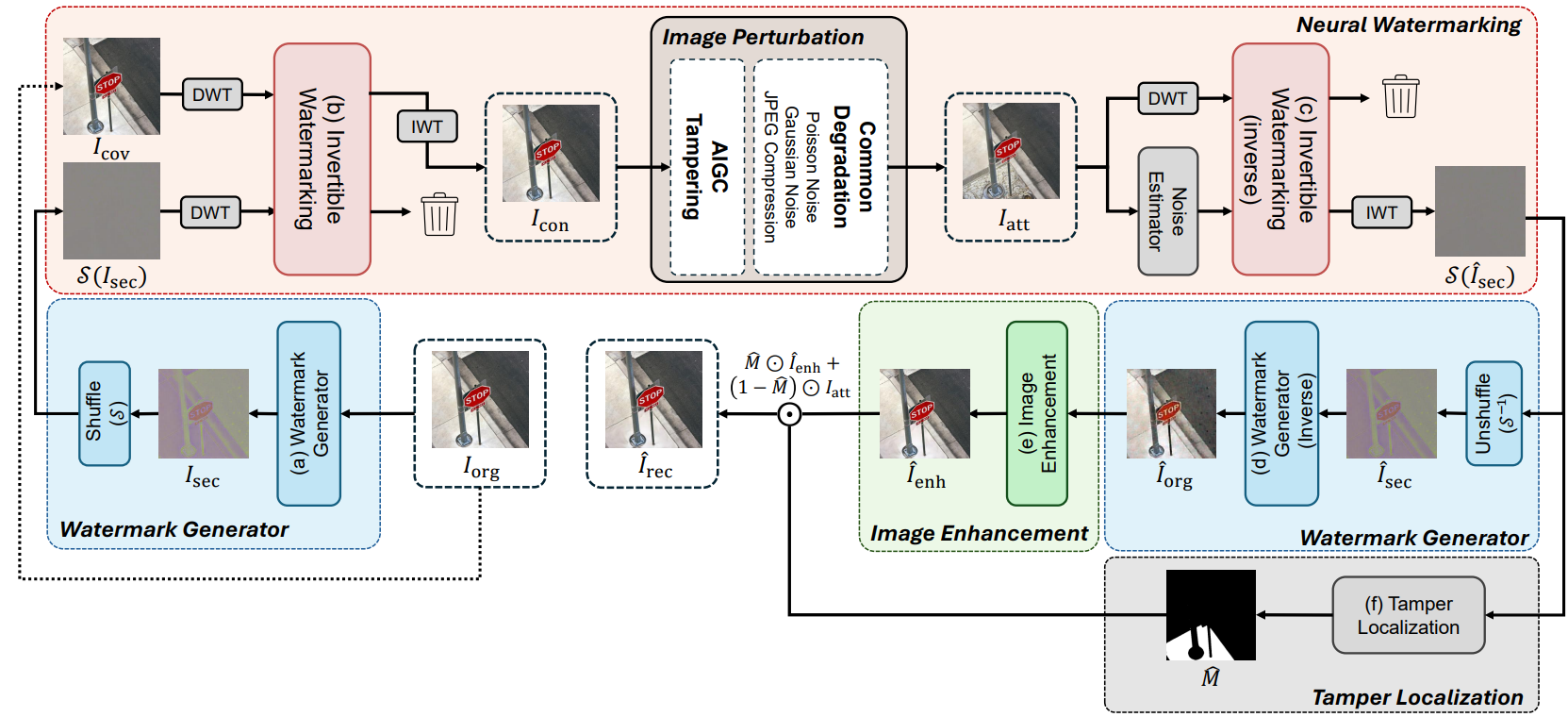
Overall Architecture of the Proposed Methods. In our framework, given a target image Iorg, module (a) generates a secret image Isec optimized for watermarking. The image is shuffled to obtain S(Isec), which is then embedded into the cover image Icov—identical to Iorg—via module (b), yielding the container image Icon. An attacker may generate a tampered image using an AI tool, resulting in the attacked image Iatt. During image self-recovery, Noise Estimator predicts the discarded noise component Înoise, which is used in module (c) to recover the shuffled secret image S(Îsec) from Iatt. This image is then unshuffled to obtain Îsec and passed through module (d) to reconstruct the target image Îorg. Module (e) refines Îorg using contextual information, producing an enhanced recovered image Îenh. Finally, module (f) locates tampered regions and restores them using corresponding untampered areas from Iatt, yielding Îrec.
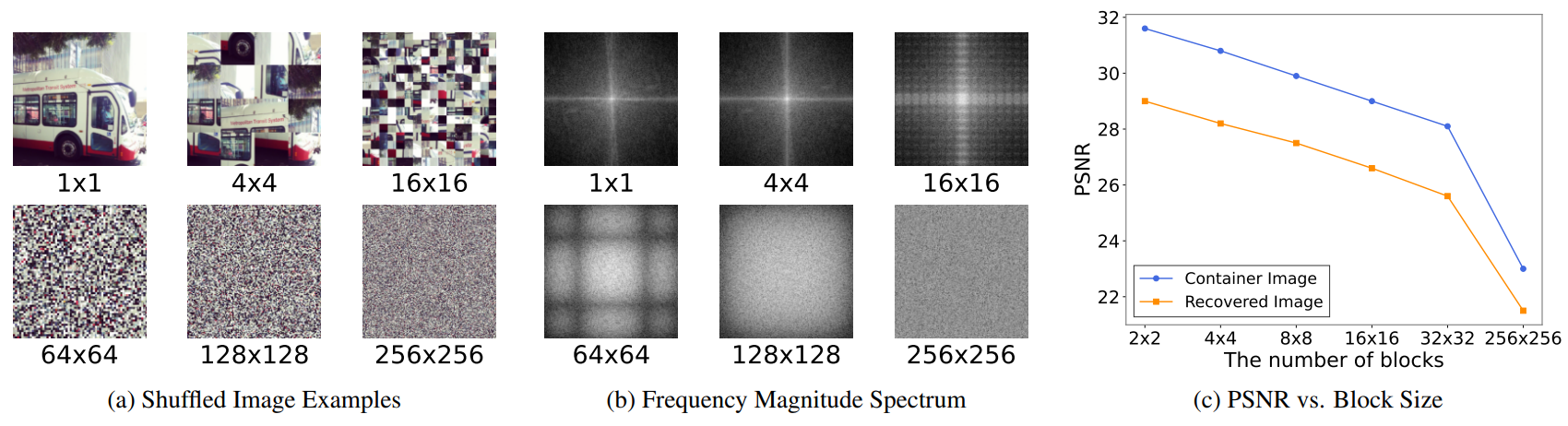
Effects of Pixel Shuffling. (a) Visualization of pixel-shuffled images with different grid configurations, defining how the image is divided into equally sized patches: finer grids introduce higher variance between neighboring pixels, indicating increased highfrequency content. (b) Magnitude spectra of the images in (a), obtained via FFT: a brighter center indicates dominant low-frequency content, suggesting a smoother image. As the patch size decreases, spectral energy spreads outward, indicating an increase in highfrequency components. (c) PSNR of container and recovered images under varying the grid configurations: both degrade significantly as the grid becomes finer, due to the increased high-frequency component.
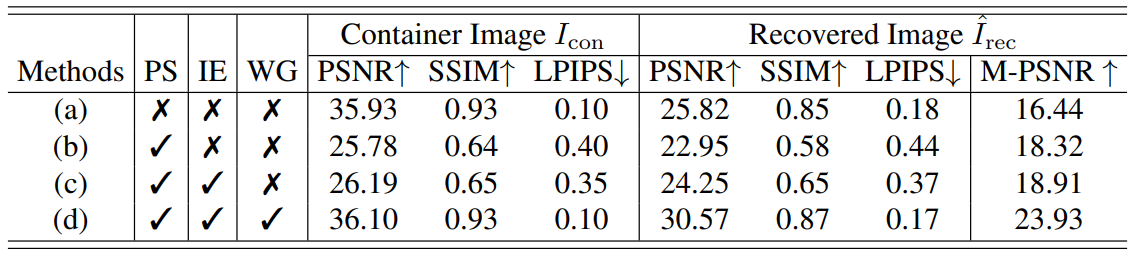
Impact of Core Components in ReImage. “PS”, “IE” and “WG” indicate Pixel Shuffling, Image Enhancement module and Watermark Generator, respectively. Using all components yields the best performance in terms of the visual quality of both container and recovered images. M-PSNR denotes the PSNR of the recovered image computed only over the tampered regions.sed high-frequency component

Comparison of Different Methods. Tampering is simulated using three methods: SD Inpaint [25], SDXL [24], and splicing following [12]. To evaluate the visual quality of the recovered and container images, we use PSNR, SSIM, and LPIPS. † We retrained W-RAE with common degradations to ensure fair comparisons, as the original model, which was trained without them, exhibited poorer recovery performance.
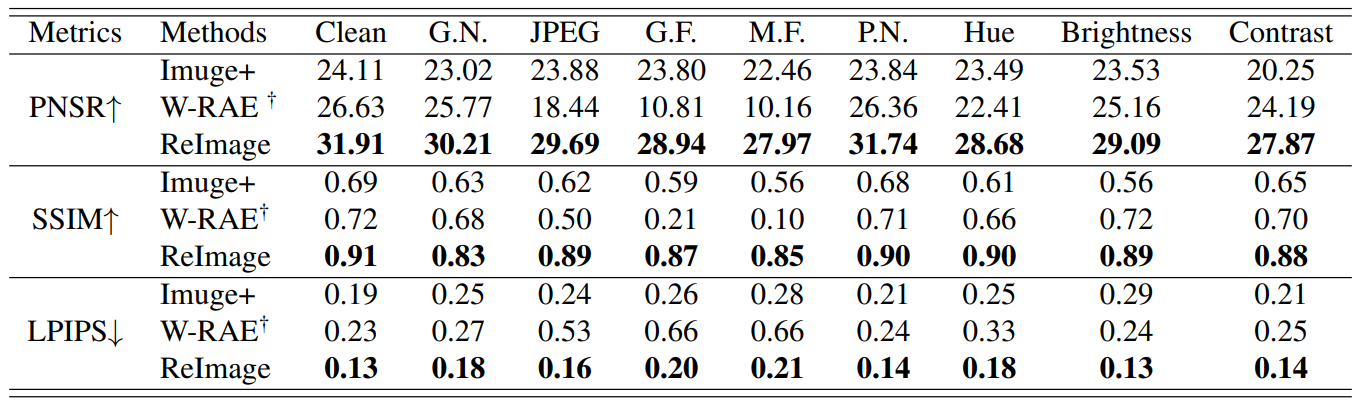
Robustness Evaluation. We evaluate robustness of models by measuring the quality of recovered images under six common degradation types: Gaussian Noise (G.N.), JPEG Compression (JPEG), Gaussian Filter (G.F.), Median Filter (M.F.), Poisson Noise (P.N.), Hue Adjustment, Brightness Adjustment and Contrast Adjustment, along with “Clean” where no degradation is applied. Note that † indicates models retrained with these degradations
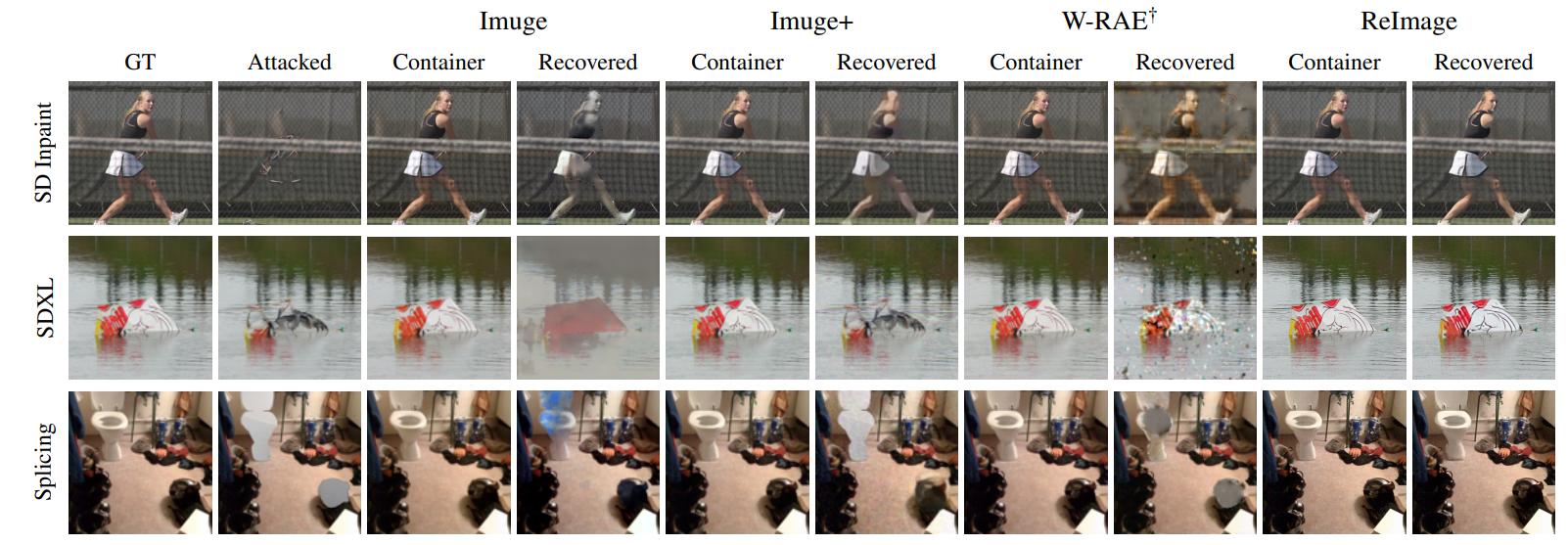
Qualitative Results of Different Methods. Visual tampering is simulated as outlined in Tab. 2. We compare our method with Imuge, Imuge+, and W-RAE†, showing that our approach yields clearer and more complete restorations.
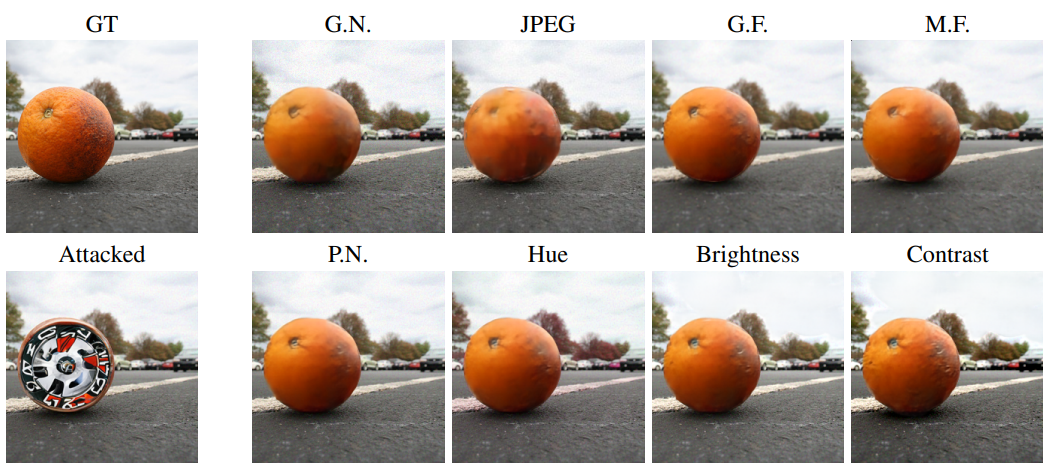
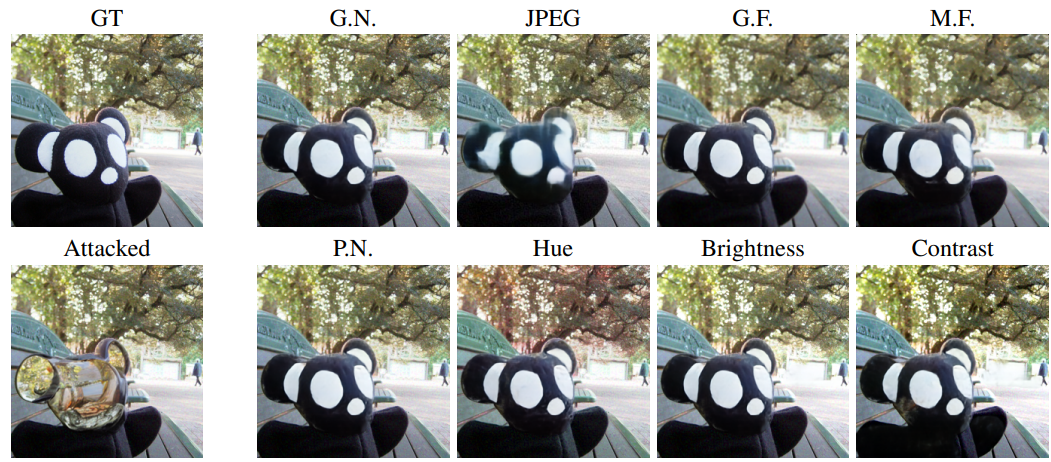
Robustness under Degradation. We qualitatively evaluate the robustness of ReImage under eight common degradation types—Gaussian Noise (G.N.), JPEG Compression (JPEG), Gaussian Filter (G.F.), Median Filter (M.F.), Poisson Noise (P.N.), Hue Adjustment, Brightness Adjustment and Contrast Adjustment.
lorem-ipsum